.svg)
The hidden tax on agency profitability: why time tracking alone won't save you


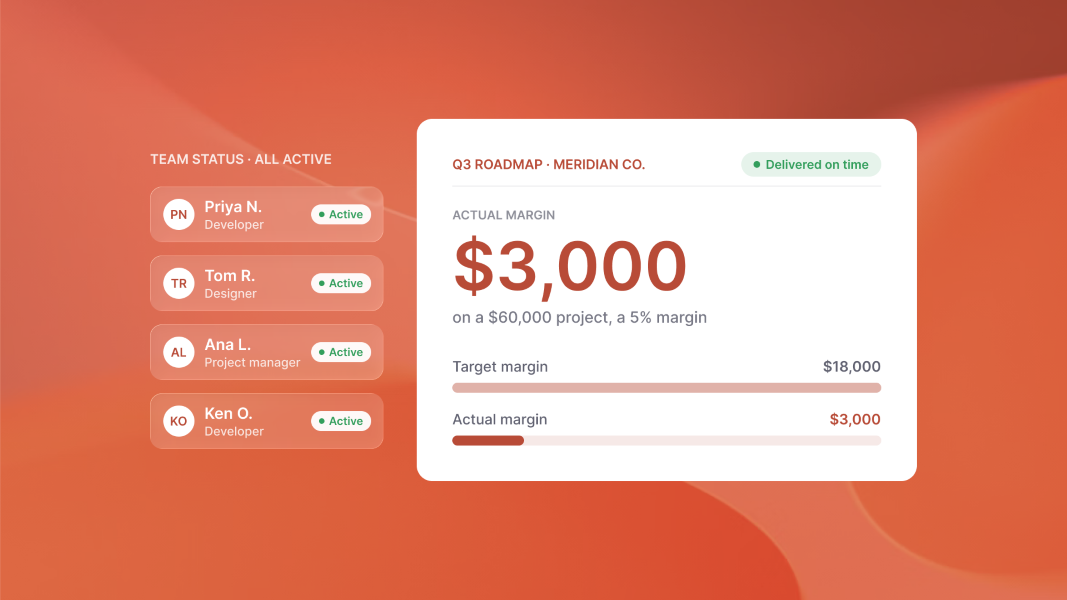
You track time religiously. Your team logs hours daily. You still lost money on that $50,000 project.
Here's the paradox: agencies invest in time tracking tools, enforce logging discipline, review timesheets weekly, yet profitability remains elusive. You're doing everything right. You're capturing hours. You're billing clients. But somehow, margins evaporate between project kickoff and final invoice.
The problem isn't your discipline. It's the tracking gap. This is an invisible space between hours worked and hours recorded. It acts like a hidden tax on every project, every client, and every quarter.
The 33% revenue leak you can't see
Manual time entry only captures 67% of actual billed work, according to TMetric's Marketing Agency Benchmarks 2025. That means one-third of your billable hours vanish before they reach an invoice. These aren't hours your team didn't work. They're hours they worked but never logged because manual entry creates friction, forgetfulness, and approximation.
The math is brutal. On that $50,000 project with 400 billable hours, you're losing roughly 133 hours to the tracking gap. At $125/hour, that's $16,625 in unrecorded revenue. The work happened. The cost occurred. The revenue disappeared.
This isn't a training problem or a motivation problem. Manual time entry costs 5-7 hours per employee per month in administrative overhead alone. Your team is spending nearly a full workday each month just trying to remember what they did.
Nearly half of agencies are hemorrhaging hours
40-47% of agencies have trouble capturing every billable hour. This causes them to lose revenue, according to the same TMetric benchmarks. This isn't a small subset of poorly managed firms. This is nearly half the industry systematically undercharging clients for work completed.
The cumulative cost reaches catastrophic levels. 47% of firms lose up to $500,000 annually on untracked hours. Half a million dollars of work performed but never billed. Services delivered but never invoiced. Value created but never captured.
For a 20-person agency billing at $150/hour, losing just 2 hours per person per week adds up to $312,000 annually. That's not theoretical shrinkage. That's real work your team completed that generated zero revenue.
.png)
The non-billable hours problem
But the tracking gap is only half the story. Non-billable hours function as an invisible tax that erodes margins before you can course-correct. Every project includes work that can't be billed: internal meetings, scope clarification, rework from unclear requirements, administrative overhead. These hours are real costs that reduce profitability even when you capture every billable minute.
The compounding effect is devastating. You lose 33% of billable hours due to tracking gaps. Then, margins shrink more as non-billable hours build up during the project.
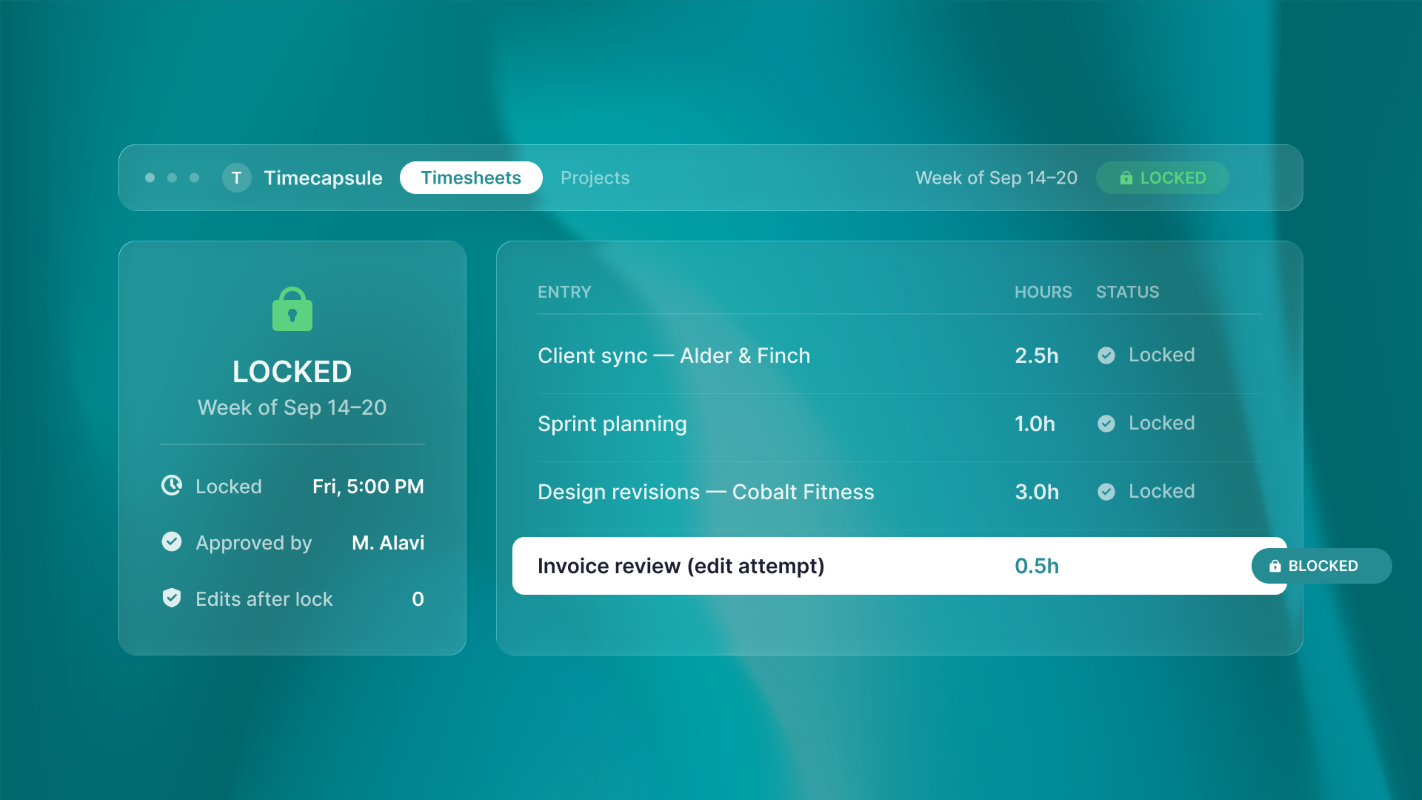
Traditional time tracking tells you what happened yesterday. It can't prevent tomorrow's losses. Tools like Timecapsule track profits in real-time. This helps teams find margin leaks quickly instead of waiting for post-mortem reports.
Counting hours doesn't equal capturing profit
Most agencies monitor hours tracked as their primary metric. That's a lagging indicator. By the time you see the hours, the damage is done. Profitable agencies monitor real-time profitability as a leading indicator, catching problems while there's still time to adjust.
The difference isn't better time tracking. It's profitability visibility that enables course correction before revenue disappears. Most agencies find losses after projects end. However, agencies with real-time monitoring spot overruns at 60% completion. They can then take action: adjust the scope, bill for changes, reallocate resources, or cut unprofitable work.
Your competitors aren't just tracking time better. They're tracking profitability faster. And in agency work, speed of visibility determines who protects margins and who explains losses in quarterly reviews.