.svg)
The hidden freelancer cost that kills agency margins before you invoice

.png)
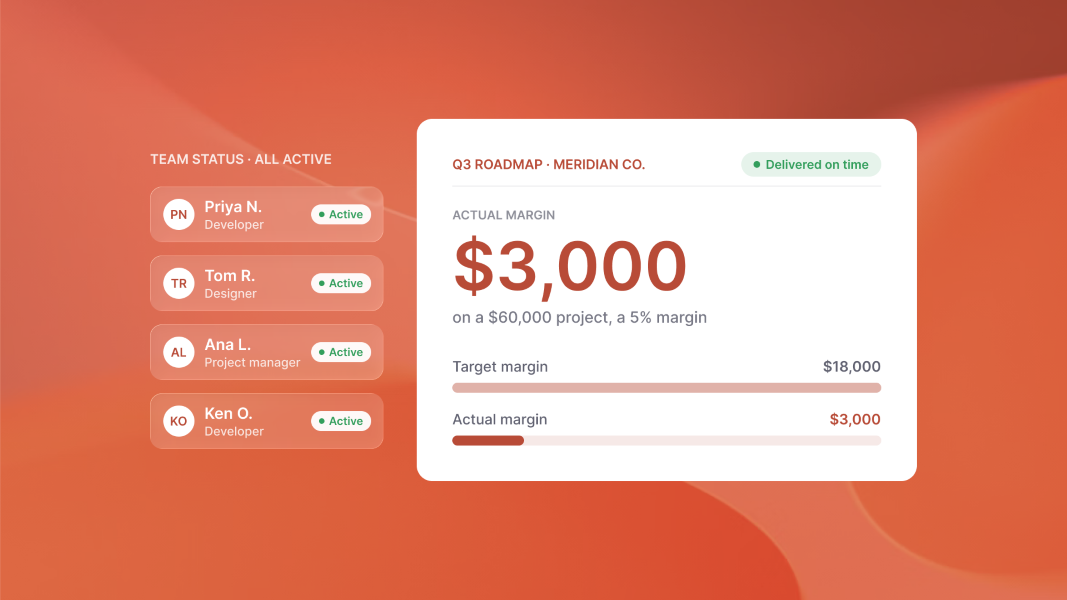
Your agency hired a freelance developer at $75/hour for a three-week project. You budgeted 120 hours, billed the client at $150/hour, and projected a healthy 50% margin. The freelancer delivered on time. You invoiced $18,000. Profitable project, right?
That $75/hour freelancer actually cost you $95-110/hour. The difference: onboarding calls, Slack coordination, code review cycles, project management overhead, and scope clarification meetings. All non-billable. All real labor costs. All invisible until after invoicing, when it's too late to protect your margin.
Here’s the industry-level problem: 48% of CEOs are increasing freelance hiring in 2026. But most agencies lack frameworks to calculate true all-in costs. They use simple 2x-4x salary multipliers that systematically underestimate by 30-50%. The difference between the projected margin and the actual margin often shows up months later during accounting reviews. By then, the damage is already permanent.
The multiplier myth that's costing you 30-50% margin
Most agencies calculate freelance costs using salary multipliers borrowed from full-time hiring. The standard approach: 2x to 4x the hourly rate to account for overhead. A $75/hour freelancer becomes $150-300/hour in your mental math.
That's not cost accounting. That's guessing. The math breaks down like this:
- Freelancer invoice: $9,000 (120 hours × $75/hour)
- Client invoice: $18,000 (120 hours × $150/hour)
- Projected margin: 50% ($9,000 profit)
But here's what you didn't track:
- Onboarding and context-sharing: 4 hours of senior developer time
- Daily Slack coordination: 12 hours of project manager time
- Code review cycles: 8 hours of tech lead time
- Scope clarification meetings: 6 hours across multiple team members
That's 30 hours of internal labor at $100/hour average cost. Add $3,000 to your freelancer cost. Your actual margin: 33%, not 50%. And that's a conservative estimate. Agencies with distributed teams or complex projects often hit 40-50 coordination hours per freelance engagement.
Hidden cost categories agencies miss
The problem isn't just coordination time. It's the invisibility of non-billable work that happens between project kickoff and final invoice. Here are the cost categories most agencies never track:

Onboarding and Context Transfer
Every freelancer needs context: codebase orientation, design system walkthrough, client background, workflow preferences. That's 3-6 hours of senior team time per engagement. You're not billing for it. You're absorbing it as overhead.
Communication Overhead
Freelancers work asynchronously across timezones. Questions come via Slack. Clarifications happen in 15-minute increments. Each interaction feels insignificant. Across three weeks, it's 10-15 hours of project manager and developer time fielding questions, reviewing progress, adjusting scope.
Quality Review Cycles
Code review, design QA, functionality testing: all internal labor. A freelancer submits work. Your team reviews it. Revision requests go back. The cycle repeats. Budget 6-10 hours per project for quality assurance that never touches the client invoice.
Timezone Misalignment
Freelancers in different timezones create coordination friction. Questions sit unanswered for 8 hours. Decisions get delayed. Your internal team compensates by working outside core hours or building buffer time into schedules. That's real cost, even if it doesn't show up on timesheets.
Scope Clarification Meetings
Freelancers aren't embedded in client relationships. When scope questions arise, they escalate to your team. Clarification meetings pull in account managers, project leads, sometimes clients. Two 30-minute calls per week adds 3-4 hours of coordination time that's pure overhead.
According to Parakeeto's agency benchmarks, target overhead must not exceed 20-30% of AGI for sustainable growth. Freelance coordination overhead often pushes agencies beyond that threshold without visibility until quarterly reviews reveal the damage.
The real cost calculator
Here's a practical framework for calculating true freelancer costs:
Step 1: Track the direct cost
Freelancer hourly rate × estimated hours = baseline cost
Step 2: Calculate coordination burden
- Onboarding: 4-6 hours × your senior developer rate
- Daily coordination: 0.5 hours/day × project duration × PM rate
- Code review: 15% of freelancer hours × tech lead rate
- Meetings: 1 hour/week × project duration × blended team rate
Step 3: Add the multiplier
Direct cost + coordination burden = true all-in cost
For that $75/hour, 120-hour freelance project:
- Direct: $9,000
- Onboarding: $600 (6 hours × $100/hour)
- Coordination: $1,500 (15 days × 0.5 hours × $100/hour PM rate)
- Code review: $1,800 (18 hours × $100/hour tech lead rate)
- Meetings: $300 (3 hours × $100/hour blended rate)
- True cost: $13,200
Your $75/hour freelancer actually costs $110/hour. Your projected 50% margin? Actually 27%. And according to Teamcamp's agency pricing guide, only 30% of agencies break the $1M revenue mark. This is mostly due to shrinking margins from untracked costs like this.
Real-time profitability visibility
The critical gap isn't calculation. It's timing. Most agencies learn freelance work is unprofitable after the final invoice. Then it is too late to adjust rates, scope, or staffing to protect margins.
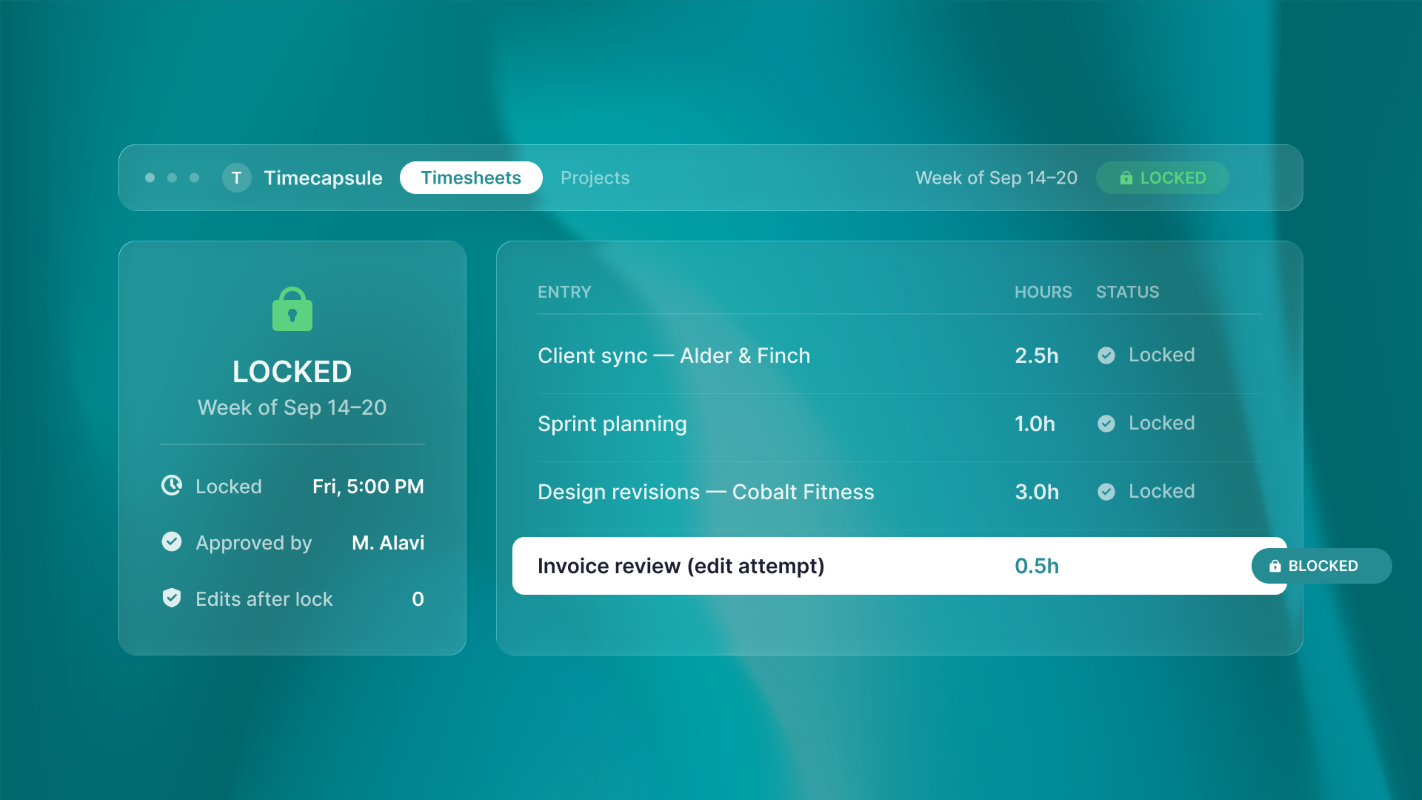
Platforms like Timecapsule track billable vs non-billable hours in real-time, monitoring project profitability as work happens. When coordination hours start exceeding budget, you see it during the project, not months later in accounting reviews.
That visibility changes decisions. You catch margin erosion when you can still adjust scope, shift resources, or renegotiate rates. You identify which freelancers require high coordination overhead vs those who operate autonomously. You build institutional knowledge about true costs instead of discovering losses retroactively.
From cost estimation to strategic intelligence
As freelance hiring nears 48% of agency capacity plans, a gap is growing. Agencies that track fully loaded costs in real time will pull ahead. Others may hit $1M in revenue later or stall with shrinking margins.
Agencies with visibility make fundamentally different decisions. They price freelance-heavy projects with accurate cost assumptions. They choose freelancers based on total engagement cost, not just hourly rates. They catch coordination overhead creep during projects when course correction is still possible.
Agencies flying blind on spreadsheets discover profitability problems in quarterly reviews, after contracts close and invoices clear. The damage is permanent. The margin is gone. The only lesson learned is that growth does not equal profitability. By then, the pattern has repeated across dozens of engagements.
Your freelancer cost calculator isn't a spreadsheet formula. It's real-time tracking that shows true all-in costs as projects unfold, when you can still protect margins instead of explaining losses.