.svg)
Where agency profit margins disappear (and how to catch the leak)


Your team worked 180 billable hours last month. Your invoice shows $27,000. But did you make money?
Most agencies treat that question like an accounting puzzle to solve after projects wrap. You track hours meticulously. You bill clients. You assume the math works out.
But here's the uncomfortable truth: time tracked does not equal profit earned.
Between the hours you log and the money you keep, three hidden profit killers can drain 15% to 30% of revenue. This guide reveals what those drains are and how to spot them while projects are running, not months later when it's too late to fix anything.
The profitability illusion
Only 35% of agencies hit every key profitability benchmark. That means 65% are leaking revenue through profit drains they don't track in real-time.
The number of unprofitable agencies rose from 13% to 21.5% in a single year. This shows that old time-tracking methods miss problems until it is too late.
You're not flying blind because you lack data. You're flying blind because you're tracking the wrong metrics.
The three hidden profit killers
Non-billable time: the silent revenue destroyer
Your team logs 40 hours per week. But how many of those hours generate client value?
Internal meetings consume 8 hours. Administrative work takes another 6. Rework from unclear requirements eats 4 more. That's 18 hours of labor cost with zero revenue attached.
Most time tracking tools do not separate billable and non-billable hours in real time. You find the problem during financial review, after it already hurts your margins.
Here's the breakdown for a mid-sized agency:
- Senior developer rate: $150/hour
- Non-billable hours per week: 18 hours
- Weekly revenue loss: $2,700
- Annual revenue leak: $140,400
That's not a rounding error. That's a senior hire you can't afford because the money evaporated into untracked overhead.
Platforms like Timecapsule track billable and non-billable ratios in real time. This helps you spot issues early, while you can still fix them.
Scope creep: the profit margin assassin
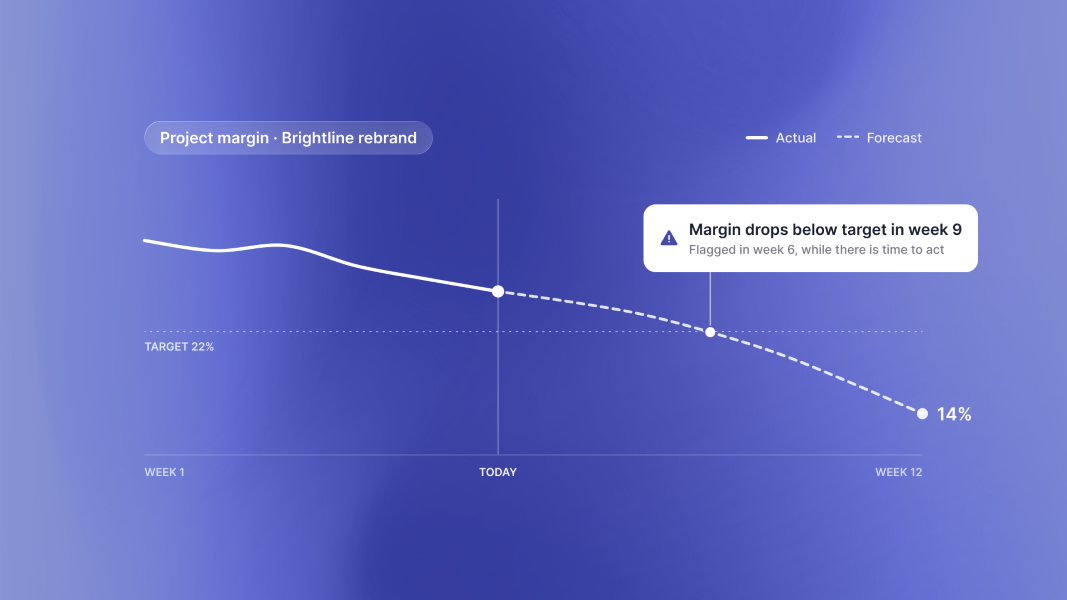
Scope creep affects 52% of projects and can quadruple initial development costs. Yet most agencies miss it until a post-mortem shows they worked 80 hours on a 40-hour quote.
The pattern looks like this:
Client requests a "small tweak" mid-sprint. Your team accommodates because relationship management matters. The tweak requires 6 hours of work you never scoped. You bill the original estimate. Your actual margin just dropped from 40% to 18%.
Scope creep doesn't announce itself. It accumulates in Slack messages and quick calls that never get logged as change requests. By the time you recognize the pattern, you've already delivered work at a loss.
Agencies like Islands manage fractional CTO work for many clients. They track time against the original scope in real time. This helps catch scope drift before it grows.
Administrative overhead: the coordination tax
Every client relationship carries administrative weight:
- Status update meetings: 2 hours/week
- Invoice preparation and follow-up: 1.5 hours/week
- Project coordination and handoffs: 3 hours/week
- Contract negotiations and renewals: 1 hour/week
That's 7.5 hours per client per week that generates zero billable value. Multiply that by 8 clients, and you spend 60 hours each week on coordination. It won’t show up on invoices, but it will show up in labor costs.
Development teams at QAflow and ReachSocial track admin overhead separately to understand true project costs, not just billable hours.
The visibility problem
You can't fix what you can't see in real-time.
Traditional time tracking tells you how many hours your team worked. It doesn't tell you whether those hours generated profit or drained it.
The agencies hitting profitability benchmarks aren't working harder. They're tracking smarter:
- They separate billable from non-billable time as it happens
- They flag scope creep the moment unplanned work starts accumulating
- They measure administrative overhead. This helps it appear in project costs. It will not show up later as a surprise line item in quarterly reviews
Agencies that discover profit problems after project completion can only improve future estimates.
Agencies that monitor profitability during execution can actually protect the margins they quoted.

What agencies miss without real-time tracking
Here's what you don't know without live profitability visibility:
- Which clients consume the most non-billable time
- Which project types consistently exceed estimated hours
- Which team members are most efficient on specific work types
- When scope drift crosses from manageable to margin-destroying
That intelligence changes which projects you pursue, which clients you retain, and how you allocate resources.
Time tracking tells you what happened. Profitability tracking tells you what to do next.