.svg)
Why time tracking shows hours but hides profit

%2520(7).png)
Your team logged 200 billable hours last month. The client paid every invoice on time. And you still lost money on the project. That's not a time tracking problem. That's a profitability visibility problem.
Most agencies track hours religiously. They monitor billable utilization rates. They generate detailed time reports. And they find out projects were unprofitable 2-3 months after they end. By then, the damage is done. The client relationship makes it hard to recover.
Time tracking shows all hours worked. But it gives no insight into whether those hours made profit or used margin.
Time tracking measures activity, not profitability
Time tracking tools capture hours worked. They calculate billable versus non-billable time. They show utilization percentages.
What they don't show: whether billable hours covered costs and generated margin.
Employee billable utilization across professional services organizations was 68.9% in 2023, according to Mosaic's 2023 Professional Services Report. That's a capacity metric, not a profitability metric. Utilization percentage doesn't distinguish profitable hours from margin-bleeding overruns. A team running at 70% utilization could be very profitable, or it could lose money on every project. The utilization number will not tell you which.
The math breaks down like this:
- Billable hours tracked: 200 hours at $150/hour = $30,000 revenue
- Team costs for those hours: $25,000 in salaries and overhead
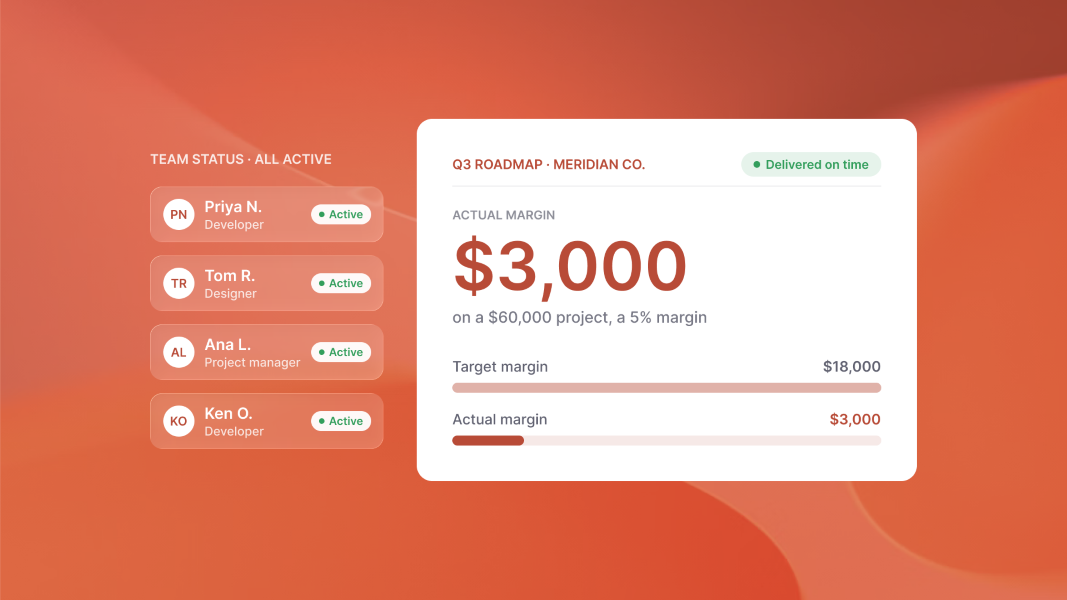
- Actual profit: $5,000 (17% margin)
But if scope creep added 40 unbilled hours to hit the deliverable, your real cost was $30,000 for $30,000 revenue. Actual profit: $0. Your time tracking system shows 200 billable hours and 68% utilization. It doesn't show you broke even.
The 15-30% profit leak agencies don't see
Agencies lose 15–30% of potential profit due to poor time tracking and scope creep. TMetric reports this in its 2025 Marketing Agency Benchmarks. That's not revenue loss. That's profit margin evaporating during project execution while your time tracking dashboard shows green.
The leak happens in the gap between hours logged and costs incurred:
- Scope creep adds unbilled work
- Inefficient execution burns extra hours
- Underpriced rates don't cover actual team costs
- Rework and revisions consume margin
Time tracking captures the billable hours. It misses the margin erosion.
When Islands reviewed Q3 project profits, they found a surprise. Some projects looked busy, with high hours and strong use, but still lost money. This happened because of execution issues that hour tracking did not show. The hours were logged. The profit was gone.
Billable hours tracked vs profit earned
Here's the core problem: billable hours measure input (time spent), not output (profit generated). A project can reach 100% of its estimated hours and bill the client in full. It can still lose money if the work costs more than the revenue.
Only 35% of agencies hit every key profitability benchmark, TMetric reports. That means 65% track time but still miss profit targets. The gap isn't time tracking accuracy. It's the absence of real-time cost visibility during project execution. The real profitability question isn't "how many hours did we bill." It's "did those billed hours cover costs and generate margin." Most agencies answer this question after the project ends. The client is already invoiced, and recovery is impossible.
Real-time profitability replaces retrospective damage assessment
Agencies using post-project profitability analysis can only document losses after invoicing. The damage is done. The client relationship makes clawback impossible. You learn the project lost money when there's nothing left to fix.
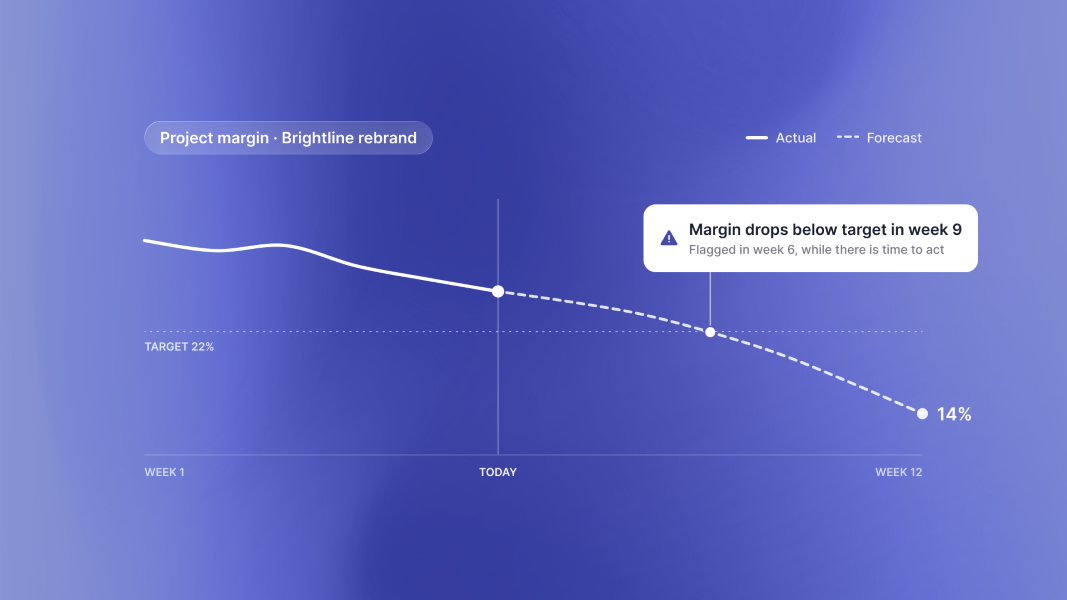
Platforms like Timecapsule monitor profitability during project execution, not after. They track billable hours against project budgets and team costs in real-time.
When a project starts bleeding margin, teams know immediately and can course-correct:
- Reduce scope through client renegotiation
- Bill overages for out-of-scope work
- Reallocate resources to protect margin
- Adjust rates for remaining deliverables
The difference:
- Old way: Track hours, invoice client, discover losses 60 days later during financial close.
- New way: Track hours plus costs, monitor margin daily, fix problems before project closes.
%2520(13).png)
Real-time profitability visibility enables preventive management. Retrospective analysis just documents how much you lost.
Time tracking is operational data, profitability is competitive intelligence
Time tracking shows what happened. Profitability tracking shows whether what happened made money.
Agencies that discover project losses after completion can only improve estimation for the next project. Agencies that know project profitability during execution make fundamentally different decisions: they protect margin while projects are active, not analyze losses after projects close.
QA flow uses real-time profitability tracking to monitor development hours against project budgets across multiple client engagements. When hours trend over budget at the 50% completion mark, they intervene before losses compound.
ReachSocial tracks feature development hours against profitability targets in real-time. They know which features generate margin and which consume it before the sprint closes.
The shift from time tracking to profitability tracking is definitional. Time tracking is a feature. Real-time profitability is competitive advantage.